
Invisible AI Fingerprint
A Watermark for Large Language Models
August 12, 2026
|arXiv (Cornell University)
Free Access English
 French
 Arabic
Abstract
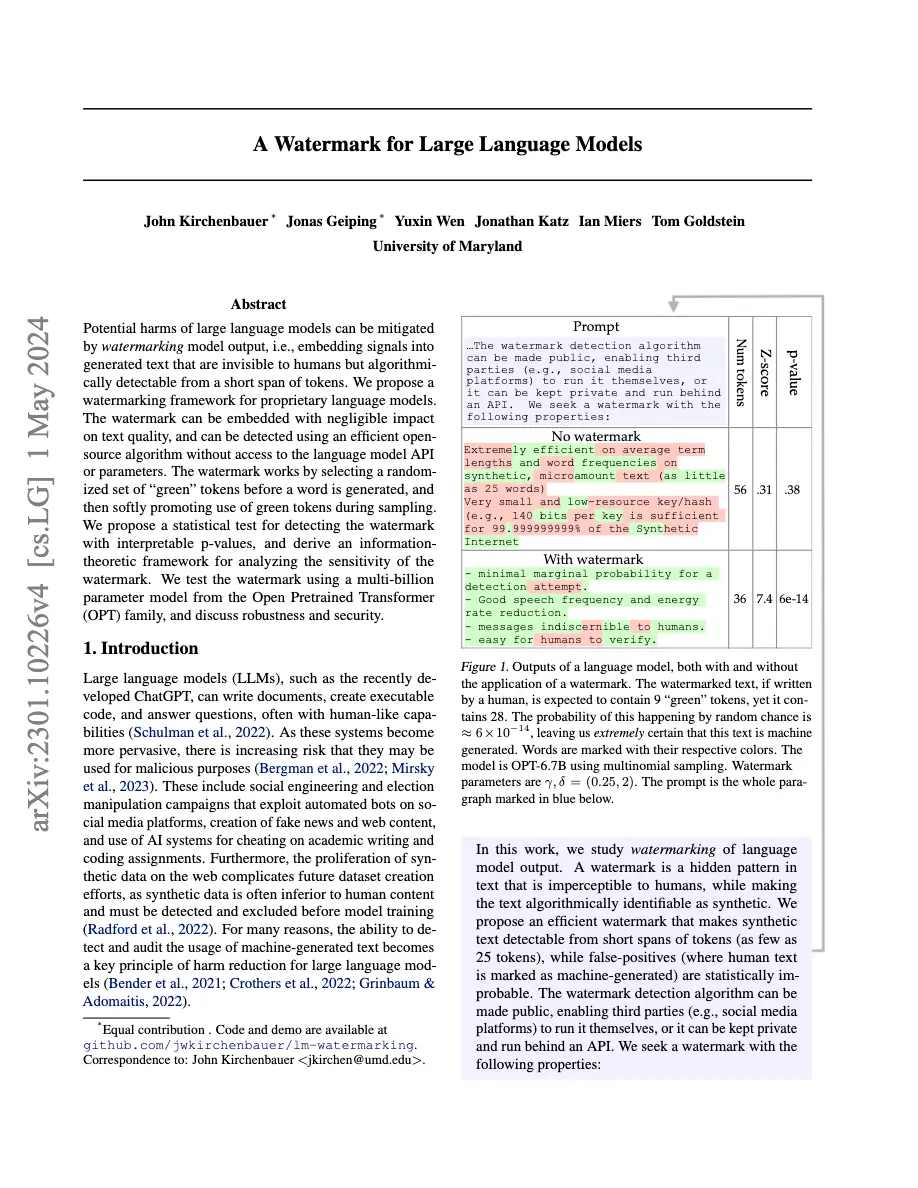
Potential harms of large language models can be mitigated by watermarking model output, i.e., embedding signals into generated text that are invisible to humans but algorithmically detectable from a short span of tokens. We propose a watermarking framework for proprietary language models. The watermark can be embedded with negligible impact on text quality, and can be detected using an efficient open-source algorithm without access to the language model API or parameters. The watermark works by selecting a randomized set of “green” tokens before a word is generated, and then softly promoting use of green tokens during sampling. We propose a statistical test for detecting the watermark with interpretable p-values, and derive an information-theoretic framework for analyzing the sensitivity of the watermark. We test the watermark using a multi-billion parameter model from the Open Pretrained Transformer (OPT) family, and discuss robustness and security.
Comments
2 comments
Please sign in to join the peer discussion timeline.
Sign Intotally get the high-entropy bit, like, for llms it feels super relevant right? trying to figure out how this *formally* maps to existing cs concepts beyond just 'more choices' is kinda wild tho, especially for things like search or planning.
yeah, i totally agree with the emphasis on clear communication. so much brilliant cs research gets lost in super dense papers, right? if we're better at translating that into understandable narratives, it could seriously boost interdisciplinary collaborations and public understanding. imagine if everyone could grasp the core ideas behind, say, quantum computing or really complex algos w/o needing a phd. that’d be huge for adoption and future breakthroughs. makes me wonder about the tools they use for this translation process, tbh.