
Undetectable Watermarks for AI
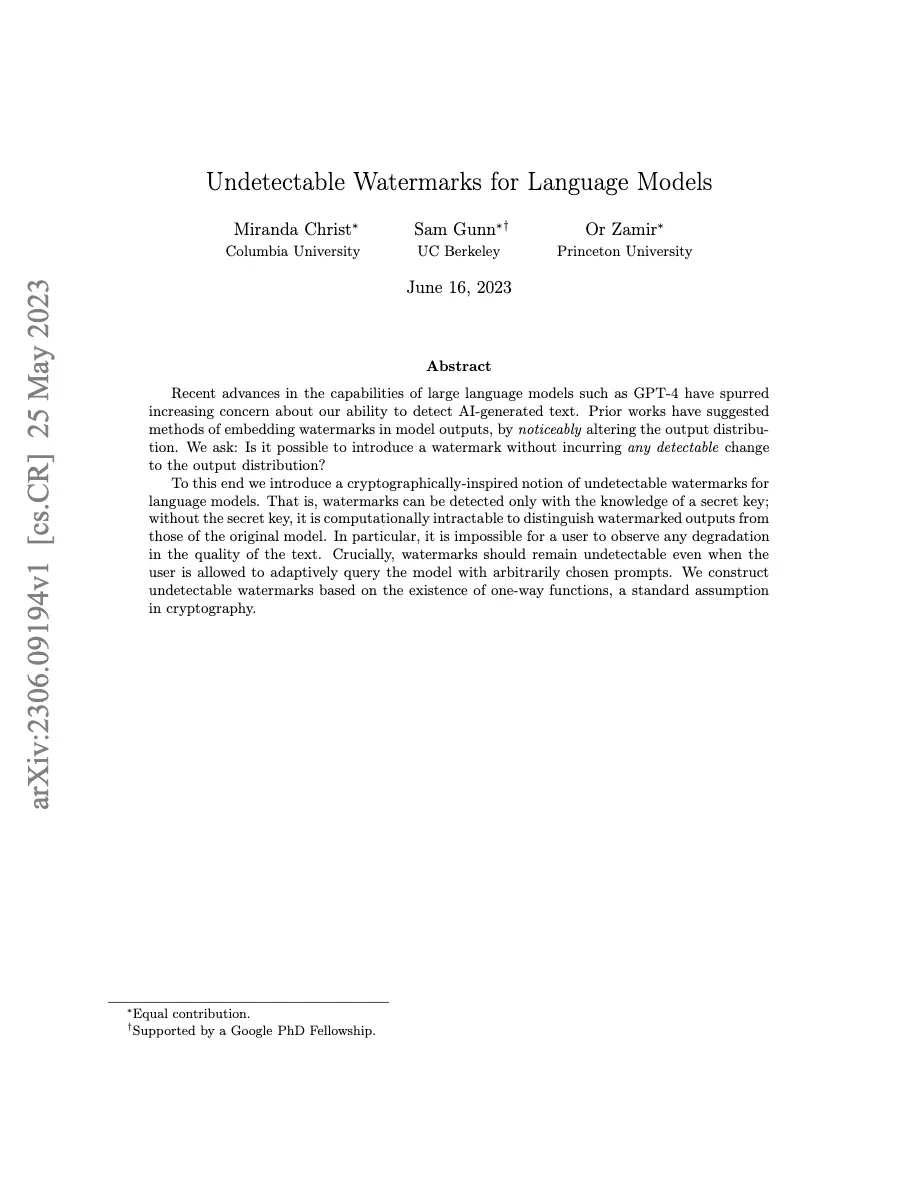
Undetectable Watermarks for Language Models
August 12, 2026
|arXiv (Cornell University)
Free Access English
 French
 Arabic
Abstract
Les progrès récents des modèles de langage de grande taille, tels que GPT-4, ont suscité des inquiétudes croissantes quant à notre capacité à détecter les textes générés par intelligence artificielle. Des travaux antérieurs ont suggéré des méthodes pour intégrer des filigranes dans les résultats des modèles, en modifiant de manière perceptible la distribution des sorties. Nous posons la question suivante : est-il possible d'introduire un filigrane sans entraîner de modification détectable de la distribution des sorties ? À cette fin, nous introduisons une notion d'origine cryptographique de filigranes indétectables pour les modèles de langage. Autrement dit, les filigranes ne peuvent être détectés qu'avec la connaissance d'une clé secrète ; sans cette clé secrète, il est impossible, d'un point de vue informatique, de distinguer les sorties filigranées de celles du modèle original. En particulier, il est impossible pour un utilisateur de constater une quelconque dégradation de la qualité du texte. Crucialement, les filigranes doivent rester indétectables même lorsque l'utilisateur est autorisé à interroger le modèle de manière adaptative avec des requêtes choisies arbitrairement. Nous construisons des filigranes indétectables basés sur l'existence de fonctions à sens unique, une hypothèse standard en cryptographie.
Comments
7 comments
Please sign in to join the peer discussion timeline.
Sign Inthis false positive issue with non-native speakers is huge. it's not just about detection accuracy, but the unfairness it creates. glad this new method addresses those biases. makes me hopeful for fairer systems.
ngl, the 'too perfect' bit kinda stuck with me too. how does this framework *really* integrate with traditional computer science paradigms? i'm thinking formal methods, algo analysis, even basic software engineering. does it fundamentally extend these established areas, or operate more as a separate, niche track? seems like 'perfect' solutions sometimes struggle with broader applicability or connecting to the existing cs ecosystem. curious to see its long-term fit.
wow, really cool summary! that bit about the model calculating next word prob distributions is kinda wild when you think about it. like, it totally flips the script on how we used to think about language processing, right? ngl, i always felt like older models were tryna 'understand' in a diff way. this just feels... more statistical, less semantic, almost? def has big implications for things like code generation, debugging, and even how we build uis, esp w/ context-aware suggestions. makes you wonder what's next for ai applications in general tbh. really solid contribution!
This is a fascinating breakdown. The point that 'Right now, most detection tools rely on post-hoc analysis' really highlights the significance of this methodology. I'm eager to see how this translates to practical applications in Computer Science.
exactly, how lms work internally was a massive blind spot.
yeah, that secret key part is huge. i mean, *knowing* it makes watermark detection simple, for sure. but the real challenge is keeping that key actually secret in the first place, right? esp for big, distributed systems. it's easy to say 'just keep it secret', but in real-world apps, keys get leaked or brute-forced. the problem really shifts from detection itself to key mgmt, which is a massive headache on its own. kinda makes ya think about overall system security more than just the watermarking tech.
Great overview. I was particularly intrigued by the claim that it is brilliant, beautifully structured, and perfectly punctuated—perhaps a bit too perfect How does this framework integrate with traditional paradigms in Computer Science?