
The AI Layoff Trap
June 12, 2026
|arXiv (Cornell University)
Free Access English
 French
Abstract
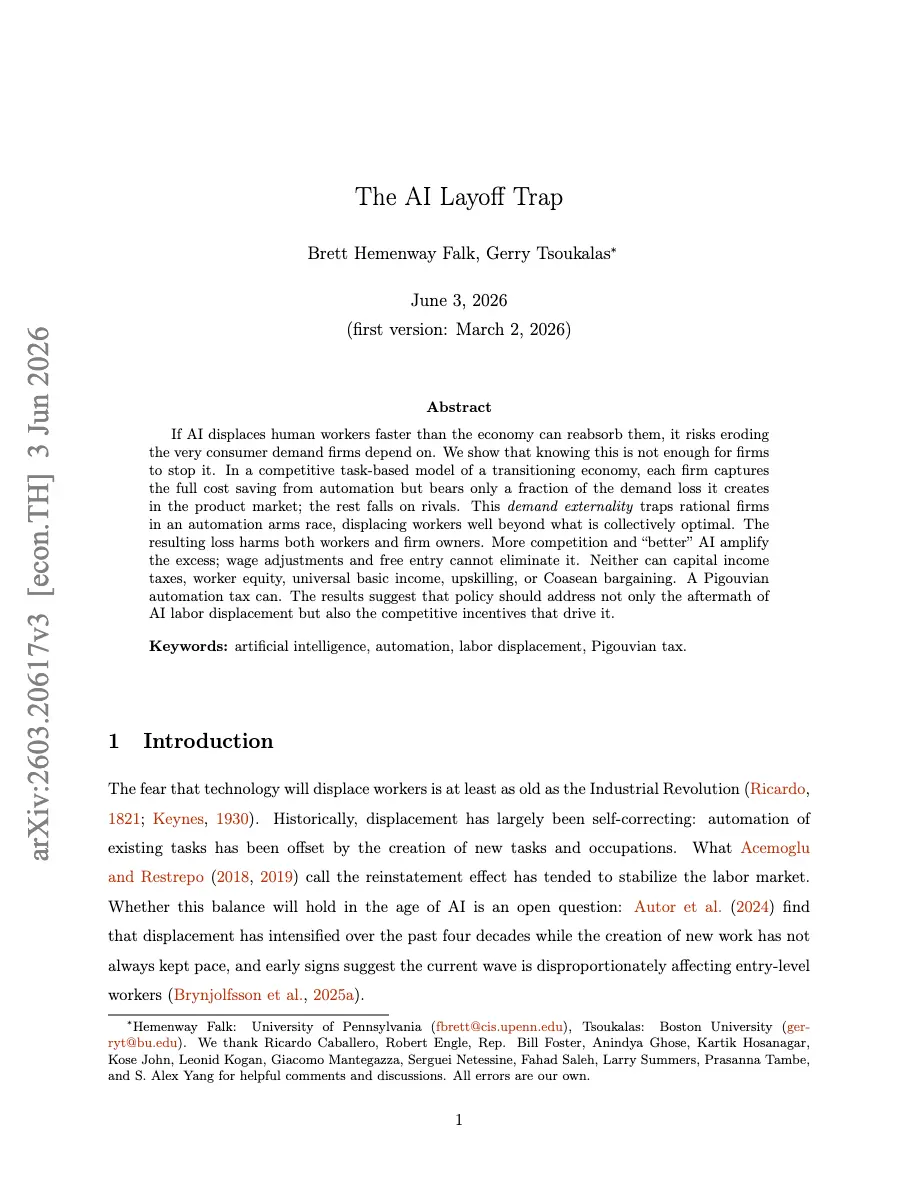
If AI displaces human workers faster than the economy can reabsorb them, it risks eroding the very consumer demand firms depend on. We show that knowing this is not enough for firms to stop it. In a competitive task-based model of a transitioning economy, each firm captures the full cost saving from automation but bears only a fraction of the demand loss it creates in the product market; the rest falls on rivals. This demand externality traps rational firms in an automation arms race, displacing workers well beyond what is collectively optimal. The resulting loss harms both workers and firm owners. More competition and “better” AI amplify the excess; wage adjustments and free entry cannot eliminate it. Neither can capital income taxes, worker equity, universal basic income, upskilling, or Coasean bargaining. A Pigouvian automation tax can. The results suggest that policy should address not only the aftermath of AI labor displacement but also the competitive incentives that drive it.
Comments
1 comment
Please sign in to join the peer discussion timeline.
Sign InThis is so good